Legal Notice Analyzer
Got a legal notice and don't know what to do next? Upload it and find out — in plain language, in minutes.
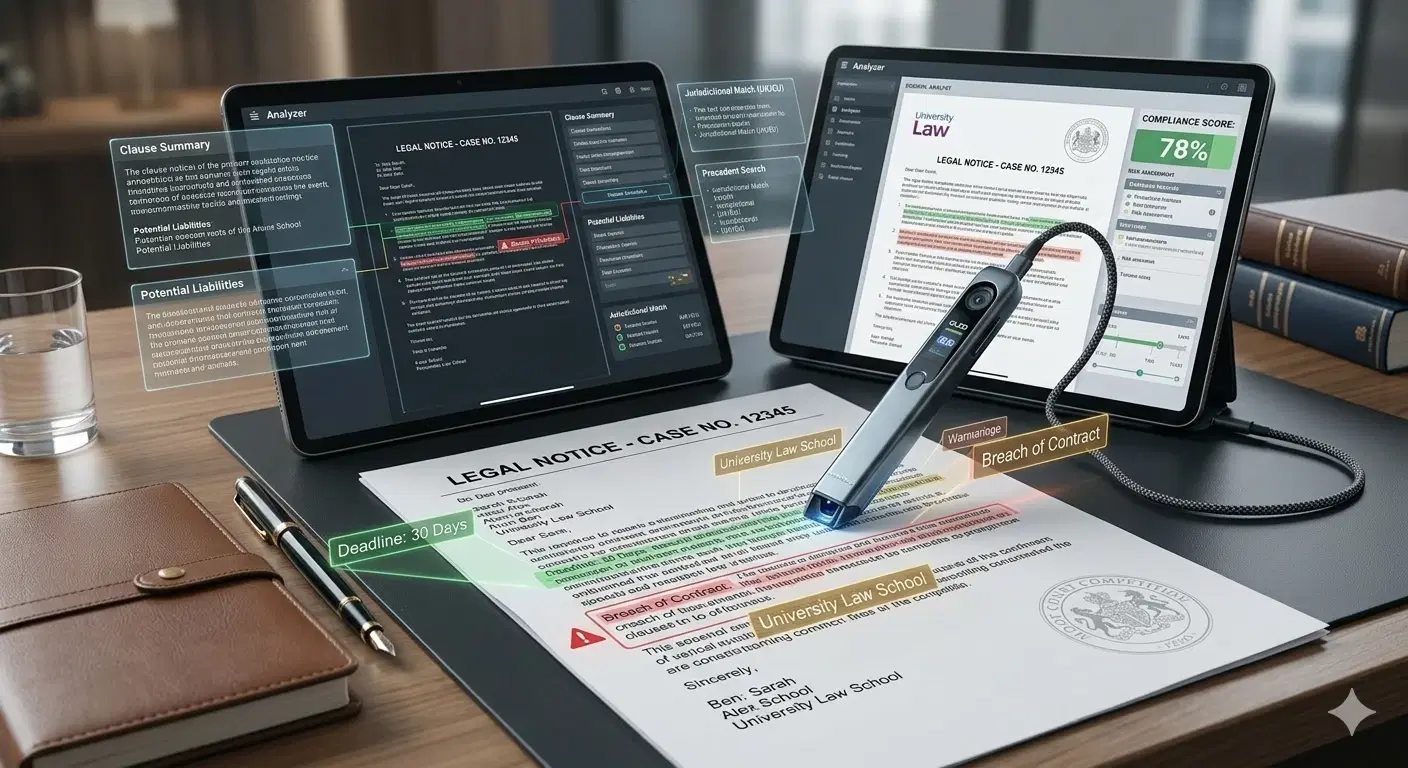
A legal notice can come from many places: a landlord, an employer, a builder, a bank over a bounced cheque, or a consumer complaint. Legal Notice Analyzer reads the document and gives you a structured breakdown — what it's claiming, what clauses matter, what your realistic response options are, and what could happen if you don't respond — built for both individuals handling their own notice and legal teams managing many.

What this workflow analyzes
- Understanding what a legal notice actually means
- Deciding how urgently to respond
- Preparing a reply to a cheque bounce, landlord, or employer notice
- Understanding what a builder or company notice is threatening
Ideal for
- Understanding what a legal notice actually means
- Deciding how urgently to respond
- Preparing a reply to a cheque bounce, landlord, or employer notice
- Understanding what a builder or company notice is threatening
- Knowing when you need to bring in a lawyer
- Understanding a cheque bounce notice under Section 138
- Responding to a landlord's or employer's legal notice
- Understanding a builder or RERA-related notice
- Replying to a consumer complaint notice
Key capabilities
Clause Extraction
Automatically identifies and explains the key clauses in your notice, in plain language.
Response Suggestions
Get practical suggestions for how to respond, based on the notice's language and how similar situations have played out.
Strengths & Risks Breakdown
See where your position is strong and where the risks are, explained simply — no legal background needed.
Benefits for your team
- Understand a legal notice without a law degree
- Faster response to time-sensitive notices
- Clear next-step guidance
- Reduces the need for a paid consultation just to understand what you received
- A structured summary you can share with a lawyer if you need one
How it works
- 1
Upload Legal Document· 1 min
Upload the notice or litigation document in supported formats.
Actions
- Upload document
- Set analysis preferences
Tips
- Use PDF or DOCX
- Avoid scanned images without OCR
- 2
Initiate AI Review· 1-2 mins
AI parses the document and identifies arguments, clauses, and legal frameworks.
Actions
- Monitor progress
- Customize outputs
GPT-4BERTLegalBERTSWOT Agent - 3
Download and Review Report· 15-30 seconds
Receive structured legal insight with actionable outputs.
Actions
- Download report
- Share with legal team
- Use references in response drafting
Expected outputs
Legal Analysis ReportPDF/HTML/JSON
A plain-English breakdown of your legal notice — what it means and what to do next.
Sections
- Summary
- Key Clauses Explained
- What You Can Do Next
- Similar Case Outcomes
- Strengths & Risks
- Conclusion
Integrates with
Security & compliance
Encryption
AES-256, TLS 1.3
Compliance
GDPR, SOC 2, PIPEDA, Legal Data Retention Policy
Access control
RBAC, 2FA, Audit Trail
Customization options
Output Focus
Choose emphasis in report generation
Technical details
AI models
GPT-4, LegalBERT, SWOT Agent, Precedent Retriever
Processing capacity
- Maxdocumentsize: 10MB
- Maxtotalsize: 50MB
- Concurrentjobs: 3
- Averageprocessingtime: 60-90 seconds
Data retention
- Resultstorage: 90 days
- Documentstorage: 30 days
- Exportavailability: Unlimited
Versioning
- Version: 1.1.0
- Last update: 2025-05-26
Support
Email: support@datacove.ai
Frequently asked questions
What should I do if I receive a legal notice in India?+
Read it carefully, note the response deadline (commonly 15–30 days), and don't ignore it — silence can be used against you later. Upload it to Legal Notice Analyzer to get a plain-language summary of the claim, the deadline, and your response options before you decide how to reply.
How do I reply to a cheque bounce notice under Section 138?+
Under the Negotiable Instruments Act, you typically have 15 days from receiving the notice to pay the cheque amount. If you dispute the claim or need more time, respond in writing through a lawyer rather than staying silent, since non-response can lead to a criminal complaint.
Is a legal notice the same as a court summons?+
No. A legal notice is a formal warning sent before a legal case is filed, giving you a chance to resolve the issue. A summons means a court case has already been filed and you're legally required to appear or respond.
How much time do I have to respond to a legal notice?+
It depends on the type of notice, but many (like cheque bounce notices) specify 15–30 days. The notice itself should state a deadline — Legal Notice Analyzer highlights this for you so you don't miss it.
Can I ignore a legal notice?+
It's risky. Ignoring a legal notice doesn't make the issue go away and can be used as evidence that you had no valid response, often making it easier for the other party to escalate to court.